Antun Jankovic
Perpetual Peace
Zagreb 2018
![]()
![]()
![]()
![]()
![]()
![]()
![]()
![]()
In keeping up with the ever-increasing demand for flexibility, the neoliberal condition found its home in the “generic city” and its “junk spaces” awaiting continuous re-design and re-branding. The design project in this master’s thesis deals both with architecture’s contended role in the generi city and with antagonism and prevailing conflict as sine qua non of politics, particularly but no only in the aftermath of the Yugoslav Wars. The first two chapters demonstrate the restlessness of hotels and their largely unchanging typologies as notable intersection points of diplomatic protocols, congress and media management, and retreat into privacy, facilitating their positioning as political and cultural capacities that invite action. Could public space and typological form challenge political rule and lobbyism in administering late capitalism? The project’s design of a hotel for the Croatian capital of Zagreb illustrates a radical departure from hospitality conventions. The third chapter con- siders Zagreb’s historical context and describes the development of the city, its fragmented urban structures, scales, and political governance in the process of opening up to various economic, social, and political pressures. In its last chapter, radical and revolutionary in nature, politicians, journalists, scientists, researchers, and activists find themselves mingling in a seemingly generic hotel where the everyday life of conflicts can be staged emblematically in everchanging set designs. Acting as a backdrop or spatial infrastructure, the “degree zero” architecture of the hotel acts as a reference or analogy for political antagonism or at least more interesting forms of dialogue—unavoidable, it frames an ideologically disputed territory of post-political practice.
![]()
@counterintuitive_typologies #croatia #zagreb #nationalboulevard #genericcity #hotel #conflict #internationalpress #politics #diplomacy #congresscenter #intelligence #protocol #exclave
“Zum ewigen Frieden. Ein architektonischer Entwurf” is a design thesis that reads the contemporary “generic city” and its junkspace through the lens of conflict, diplomacy, and peace-making, and then condenses this reading into a single, highly programmed hotel-institution in central Zagreb. Written at TU Graz in 2018, it takes Kant’s essay Zum ewigen Frieden as both title and foil, asking how architecture might offer not a utopian end of war, but a concrete spatial infrastructure in which political antagonisms can be staged, negotiated, and temporarily stabilised.
The thesis is organised in four parts—Thematik, Typus, Topos, Tektonik—that move from a broad political history of the city, through the genealogy of political interiors, to a precise site and finally to a projective building proposal. The first part reconstructs the evolution from Greek polis and Roman urbs to bourgeois capitalism and neoliberal urbanism, drawing on Foucault, Habermas, Koolhaas, and Aureli. The “postmodern urbanism” of Las Vegas, Non-Stop City, and Manhattan’s “City of the Captive Globe” appears as the spatial correlate of Homo oeconomicus: a city of consumption, branding, and functional indifference in which public life is increasingly outsourced to commercial interiors. Parallel chapters on “Krieg und Frieden” and “Konsens, kein Konflikt” read modern war and diplomacy via Clausewitz and Kant, arguing that contemporary politics is less about open ideological conflict and more about managed negotiations, consensus-building, and post-political procedures.
Against this backdrop, the second part (Typus) focuses on the hotel as a political typology. It traces a genealogy from agora, forum, absolutist court, salon, and coffee house to parliament, conference centre, and finally the global business hotel. Using Habermas’s notion of the public sphere, the thesis shows how political decision-making gradually moved from open urban spaces into increasingly scripted interiors. Versailles’ sequence of antechambers and council rooms is read as an early spatial protocol of power; later, the hotel becomes the dispersed parliament of diplomacy, hosting summits, negotiations, and media management while hiding them inside a standardised corridor-and-room layout. The hotel emerges as a paradoxical figure: at once a capitalist machine for transient guests and a de facto political institution where treaties are drafted, crises are managed, and “perpetual peace” is always negotiated but never achieved.
The third part (Topos) anchors this typological argument in Zagreb. It reconstructs the city’s central north–south axis from the 19th-century “Green Horseshoe” and main station across the Sava towards Novi Zagreb, often described as Zagreb’s Champs-Élysées. Within this axis lies the Paromlin industrial complex—a former steam mill complex near the railway, now largely ruined through fires, neglect, and political indifference. Competing visions have projected onto Paromlin a city library, luxury Marriott hotel, speculative high-rise and Europan schemes, without any being realised. The thesis interprets this as “Kulturozid”: systematic erasure of industrial heritage through inaction and opportunism. It rejects nostalgic preservation, but insists that the site must be reactivated with a high-intensity public programme rather than reduced to parking or residual green.
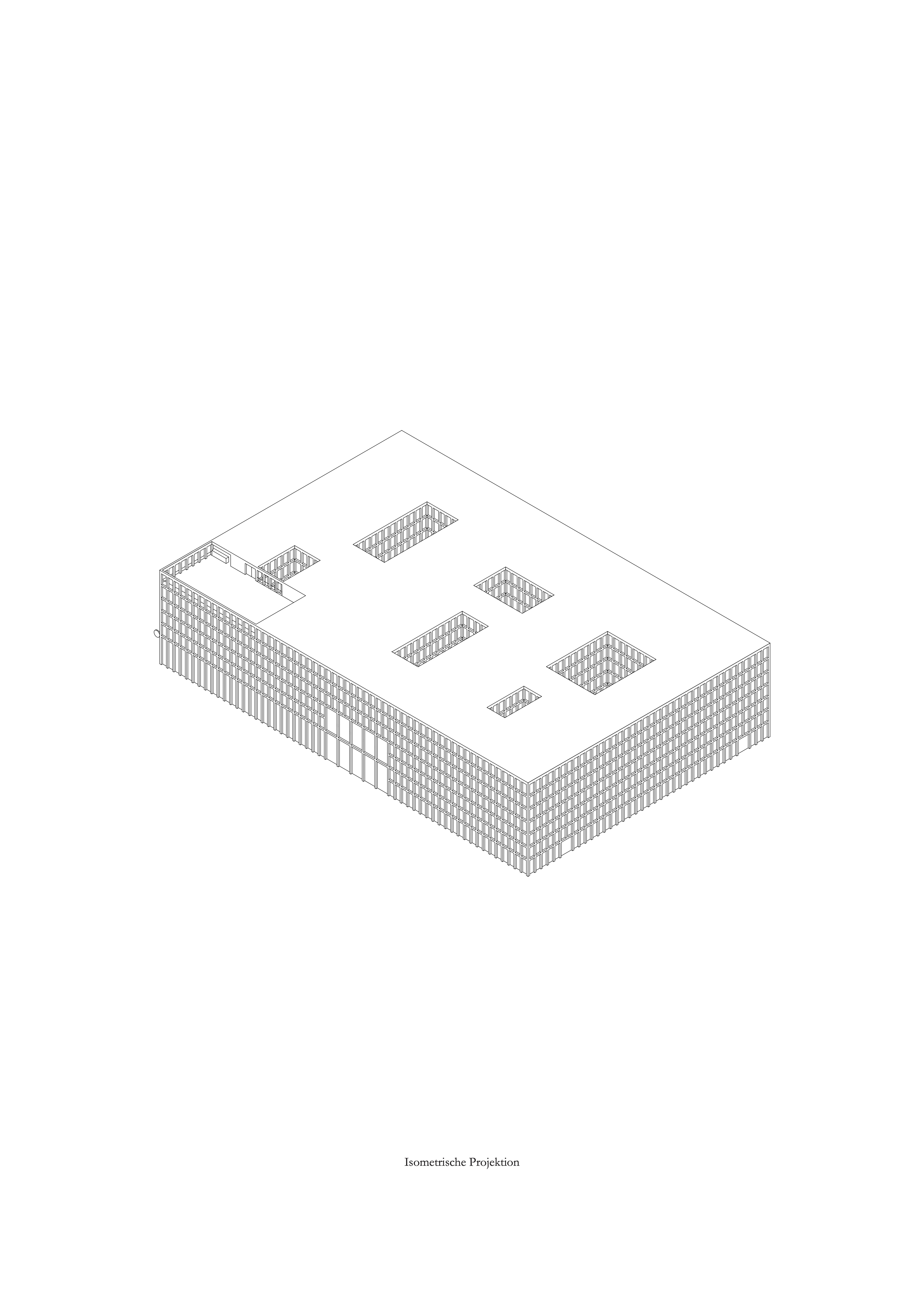
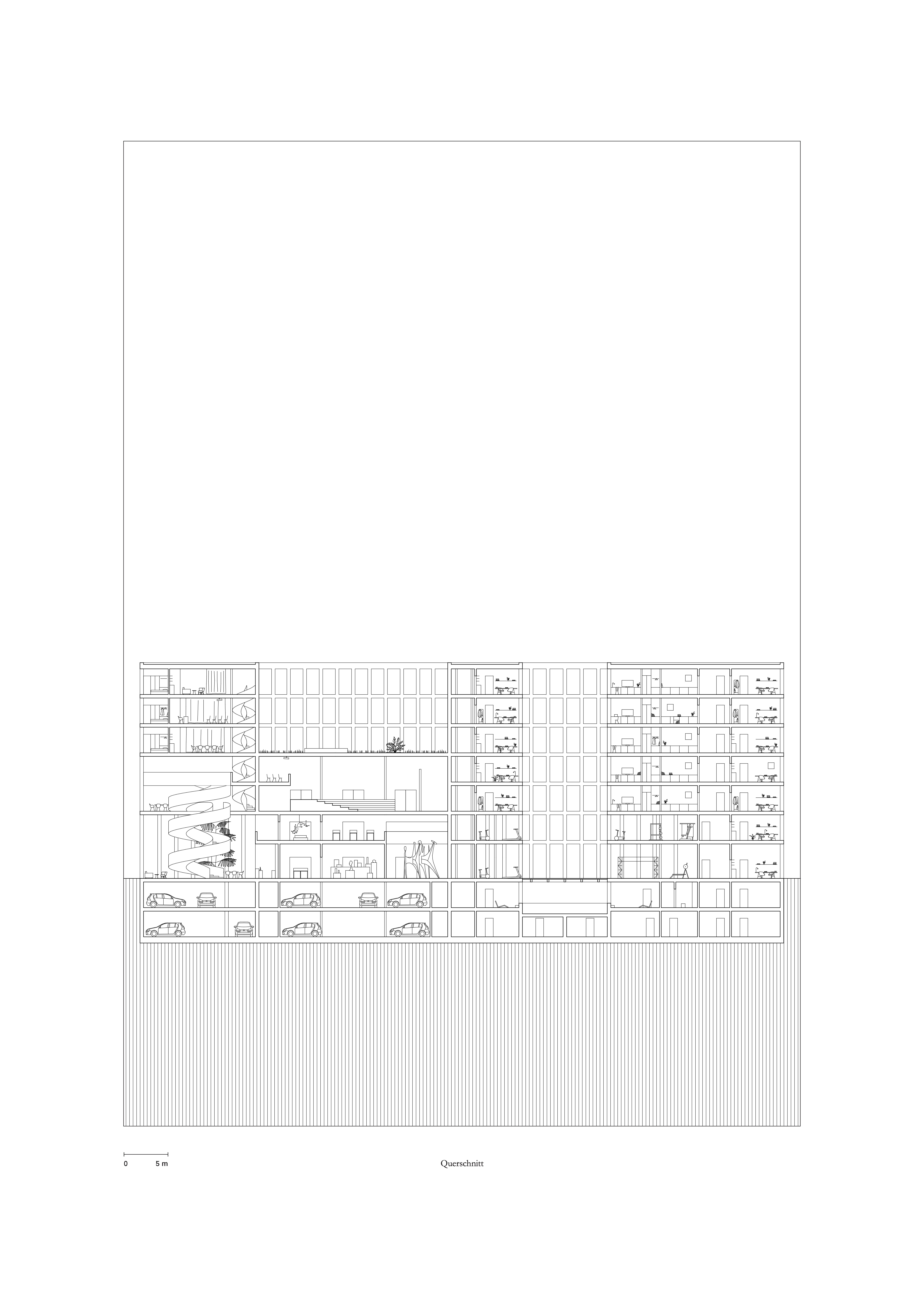
The final part (Tektonik) translates these arguments into a concrete design. On the footprint of the former mill, opposite a new park and adjacent to a public plaza, the project proposes a six-storey, 100 × 72 m closed cube that combines hotel and political institution into a single, dense urban artefact. A simple structural grid, a “minimum of architecture and maximum of programme,” sets up an autonomous, robust form that counters the surrounding fragmentary fabric and aligns itself with Zagreb’s sequence of axis-monuments. Ground level is conceived as an extended urban lobby: a thick band of everyday functions—library, restaurants, bakery, patisserie, mini-shops, fitness, hairdresser, beauty salon, coworking forum, exhibition spaces—that are accessible both from the street and through internal courtyards. A café spills onto the plaza, deliberately blurring the boundary between hotel base and public space.
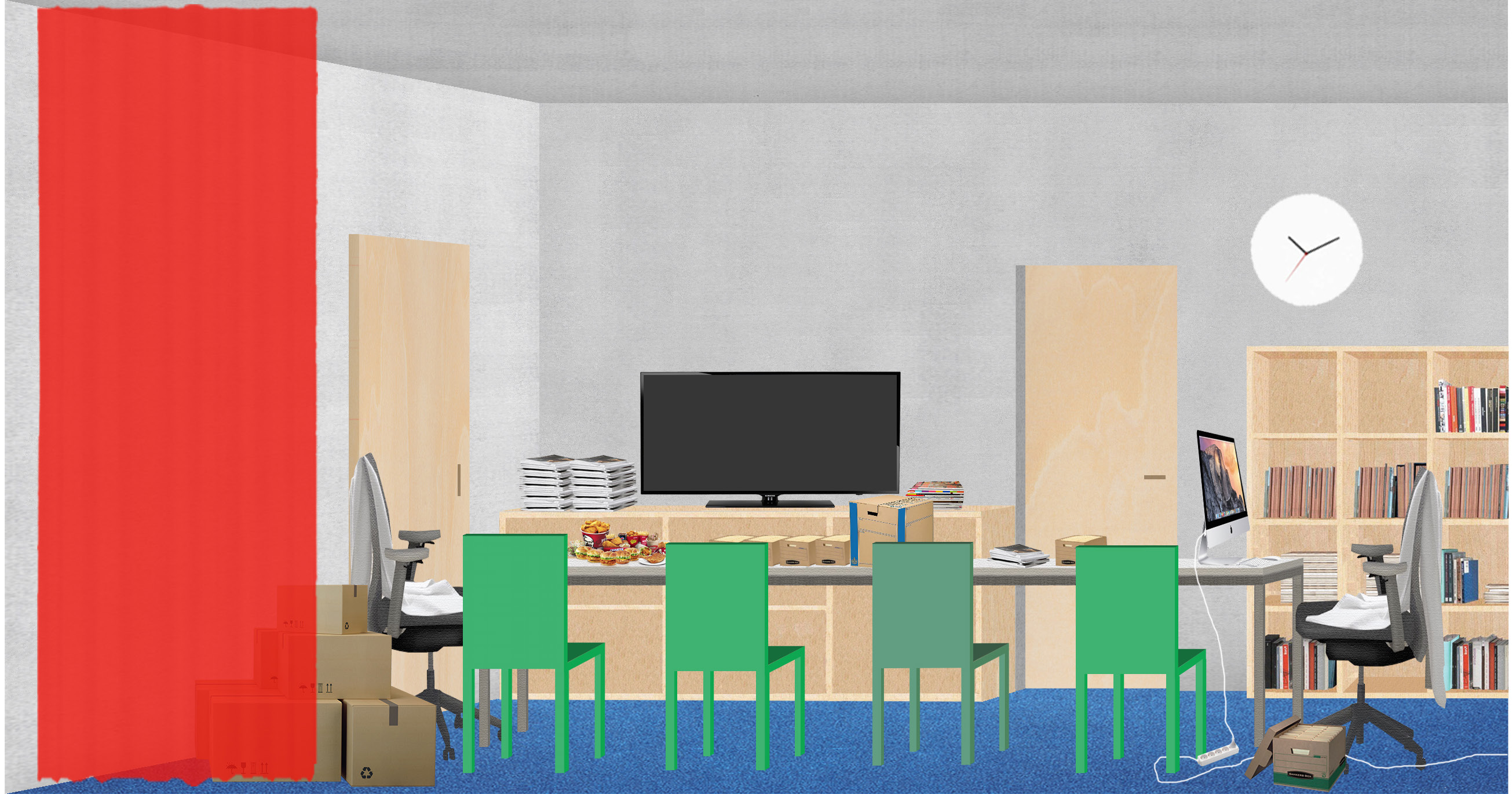
A multi-storey spiral stair in the entrance hall forms the symbolic and functional hinge between the congress/political areas and the more informal ground-floor programmes, while four stair cores with lifts serve the upper hotel levels. These upper floors accommodate exactly 390 generously sized rooms arranged along façades to secure natural light. Rooms are conceived less as private cells than as flexible work-living units: some combine sleeping, working, and hosting; others can be linked across party walls to form temporary suites or campaign headquarters. Oversized corridors are intermittently thickened into programmed niches—lounges, meeting alcoves, service points—so that the corridor becomes an “interior street” where public and intimate spheres continually negotiate with one another. A neutral, gridded façade gives the cube both use-indifference and monumental presence, while large openings and orthogonal alignment to the park maintain long views in all directions.
In sum, the design thesis recasts the hotel as a “degree zero” architecture for political antagonism: a generic yet highly structured interior in which journalists, activists, politicians, and experts can inhabit conflict rather than suppress it, and where the generic city’s last bastion—the hotel itself—is turned into a laboratory for post-democratic work instead of another container of depoliticised comfort.
Facebook album
Perpetual Peace
Zagreb 2018




In keeping up with the ever-increasing demand for flexibility, the neoliberal condition found its home in the “generic city” and its “junk spaces” awaiting continuous re-design and re-branding. The design project in this master’s thesis deals both with architecture’s contended role in the generi city and with antagonism and prevailing conflict as sine qua non of politics, particularly but no only in the aftermath of the Yugoslav Wars. The first two chapters demonstrate the restlessness of hotels and their largely unchanging typologies as notable intersection points of diplomatic protocols, congress and media management, and retreat into privacy, facilitating their positioning as political and cultural capacities that invite action. Could public space and typological form challenge political rule and lobbyism in administering late capitalism? The project’s design of a hotel for the Croatian capital of Zagreb illustrates a radical departure from hospitality conventions. The third chapter con- siders Zagreb’s historical context and describes the development of the city, its fragmented urban structures, scales, and political governance in the process of opening up to various economic, social, and political pressures. In its last chapter, radical and revolutionary in nature, politicians, journalists, scientists, researchers, and activists find themselves mingling in a seemingly generic hotel where the everyday life of conflicts can be staged emblematically in everchanging set designs. Acting as a backdrop or spatial infrastructure, the “degree zero” architecture of the hotel acts as a reference or analogy for political antagonism or at least more interesting forms of dialogue—unavoidable, it frames an ideologically disputed territory of post-political practice.

@counterintuitive_typologies #croatia #zagreb #nationalboulevard #genericcity #hotel #conflict #internationalpress #politics #diplomacy #congresscenter #intelligence #protocol #exclave
“Zum ewigen Frieden. Ein architektonischer Entwurf” is a design thesis that reads the contemporary “generic city” and its junkspace through the lens of conflict, diplomacy, and peace-making, and then condenses this reading into a single, highly programmed hotel-institution in central Zagreb. Written at TU Graz in 2018, it takes Kant’s essay Zum ewigen Frieden as both title and foil, asking how architecture might offer not a utopian end of war, but a concrete spatial infrastructure in which political antagonisms can be staged, negotiated, and temporarily stabilised.
The thesis is organised in four parts—Thematik, Typus, Topos, Tektonik—that move from a broad political history of the city, through the genealogy of political interiors, to a precise site and finally to a projective building proposal. The first part reconstructs the evolution from Greek polis and Roman urbs to bourgeois capitalism and neoliberal urbanism, drawing on Foucault, Habermas, Koolhaas, and Aureli. The “postmodern urbanism” of Las Vegas, Non-Stop City, and Manhattan’s “City of the Captive Globe” appears as the spatial correlate of Homo oeconomicus: a city of consumption, branding, and functional indifference in which public life is increasingly outsourced to commercial interiors. Parallel chapters on “Krieg und Frieden” and “Konsens, kein Konflikt” read modern war and diplomacy via Clausewitz and Kant, arguing that contemporary politics is less about open ideological conflict and more about managed negotiations, consensus-building, and post-political procedures.
Against this backdrop, the second part (Typus) focuses on the hotel as a political typology. It traces a genealogy from agora, forum, absolutist court, salon, and coffee house to parliament, conference centre, and finally the global business hotel. Using Habermas’s notion of the public sphere, the thesis shows how political decision-making gradually moved from open urban spaces into increasingly scripted interiors. Versailles’ sequence of antechambers and council rooms is read as an early spatial protocol of power; later, the hotel becomes the dispersed parliament of diplomacy, hosting summits, negotiations, and media management while hiding them inside a standardised corridor-and-room layout. The hotel emerges as a paradoxical figure: at once a capitalist machine for transient guests and a de facto political institution where treaties are drafted, crises are managed, and “perpetual peace” is always negotiated but never achieved.
The third part (Topos) anchors this typological argument in Zagreb. It reconstructs the city’s central north–south axis from the 19th-century “Green Horseshoe” and main station across the Sava towards Novi Zagreb, often described as Zagreb’s Champs-Élysées. Within this axis lies the Paromlin industrial complex—a former steam mill complex near the railway, now largely ruined through fires, neglect, and political indifference. Competing visions have projected onto Paromlin a city library, luxury Marriott hotel, speculative high-rise and Europan schemes, without any being realised. The thesis interprets this as “Kulturozid”: systematic erasure of industrial heritage through inaction and opportunism. It rejects nostalgic preservation, but insists that the site must be reactivated with a high-intensity public programme rather than reduced to parking or residual green.
The final part (Tektonik) translates these arguments into a concrete design. On the footprint of the former mill, opposite a new park and adjacent to a public plaza, the project proposes a six-storey, 100 × 72 m closed cube that combines hotel and political institution into a single, dense urban artefact. A simple structural grid, a “minimum of architecture and maximum of programme,” sets up an autonomous, robust form that counters the surrounding fragmentary fabric and aligns itself with Zagreb’s sequence of axis-monuments. Ground level is conceived as an extended urban lobby: a thick band of everyday functions—library, restaurants, bakery, patisserie, mini-shops, fitness, hairdresser, beauty salon, coworking forum, exhibition spaces—that are accessible both from the street and through internal courtyards. A café spills onto the plaza, deliberately blurring the boundary between hotel base and public space.
A multi-storey spiral stair in the entrance hall forms the symbolic and functional hinge between the congress/political areas and the more informal ground-floor programmes, while four stair cores with lifts serve the upper hotel levels. These upper floors accommodate exactly 390 generously sized rooms arranged along façades to secure natural light. Rooms are conceived less as private cells than as flexible work-living units: some combine sleeping, working, and hosting; others can be linked across party walls to form temporary suites or campaign headquarters. Oversized corridors are intermittently thickened into programmed niches—lounges, meeting alcoves, service points—so that the corridor becomes an “interior street” where public and intimate spheres continually negotiate with one another. A neutral, gridded façade gives the cube both use-indifference and monumental presence, while large openings and orthogonal alignment to the park maintain long views in all directions.
In sum, the design thesis recasts the hotel as a “degree zero” architecture for political antagonism: a generic yet highly structured interior in which journalists, activists, politicians, and experts can inhabit conflict rather than suppress it, and where the generic city’s last bastion—the hotel itself—is turned into a laboratory for post-democratic work instead of another container of depoliticised comfort.
Facebook album
ARCHITEKT ANDREAS LECHNER
Attemsgasse 11
8010 Graz
Austria
![]()
Attemsgasse 11
8010 Graz
Austria

Staatlich befugter und beeideter Ziviltechniker
© Andreas Lechner. All rights reserved. Unless otherwise stated, all materials on this website and the ideas incorporated herein, as an instrument of professional service, are protected by copyright and other intellectual property rights belonging to Andreas Lechner, its affiliates or its licensors and all such rights are hereby asserted and reserved. No part of this website may be copied, reproduced, republished, posted, transmitted or distributed in any way for commercial purposes. Any modification or use of the information contained on this website for any purpose not explicitly permitted without prior written consent is a violation of the author’s intellectual property rights and is strictly prohibited.
CV · Imprint
CV · Imprint