Counterintuitive Typologies
![]()
![Fig. 1 Robert Venturi’s “Recommendation for a monument” (1972) next to Madrid PKMN Architectures greenish update from 2014.]()
![]()
![]()
![]()
![]()
![]()
![]()
Fig. 6 Poster for the 2021–22 Architectural Research Lecture Series at TU Graz.
![]()
Fig. 7 “Counterintuitive Typologies”: design studios conducted at TU Graz, 2020–23.
![]()
![]()
![]()
![]()
![]()
![]()
![]()
![]()
![]()
![]()
![]()
![]()
Fig. 8 Posters for design studios on “Counterintuitive Typologies” at TU Graz, 2020–23.
“The architect who would accept his role as combiner of significant old clichés—valid banalities—in new contexts as his condition within a society that directs its best efforts, its big money, and its elegant technologies elsewhere, can ironically express in this indirect way a true concern for society’s inverted scale of values.”
Robert Venturi, Complexity and Contradiction in Architecture (1966)

Fig. 1 Robert Venturi, “Recommendation for a Monument,” 1972.

Fig. 2 Robert Venturi’s “Recommendation for a Monument” (1972) alongside its reinterpretation by Madrid-based PKMN Architectures (2014).


Fig. 3 Posters for Andreas Lechner’s 2022 lecture “Counterintuitive Typologies,” incorporating twelve master’s theses on counterintuitive monuments, continual building, and adaptive reuse.
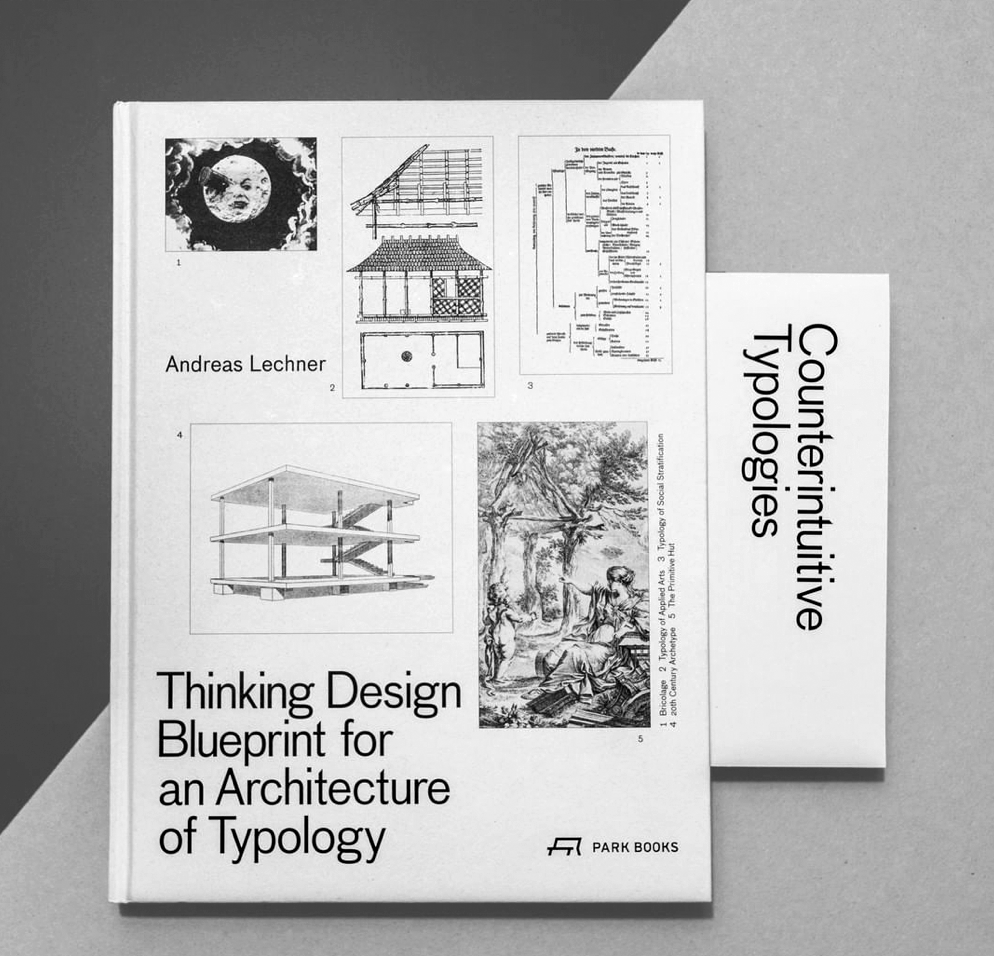
Fig. 4 Counterintuitive Typologies, appended booklet presenting twelve master’s theses, in Andreas Lechner, Thinking Design—Blueprint for an Architecture of Typology (Zurich: Park Books, 2021).

Fig. 5 Spreads from the appended booklet Counterintuitive Typologies in Thinking Design—Blueprint for an Architecture of Typology (Park Books, 2021).

Fig. 6 Poster for the 2021–22 Architectural Research Lecture Series at TU Graz.

Fig. 7 “Counterintuitive Typologies”: design studios conducted at TU Graz, 2020–23.


Fig. 8 Posters for design studios on “Counterintuitive Typologies” at TU Graz, 2020–23.
Research and teaching program
Counterintuitive Typologies is the title and guiding principle of Andreas Lechner’s research and teaching programme. Developed across design studios, supervised master’s theses, publications, international collaborations, and funded research, it investigates how typological thinking can contribute to the transformation of existing buildings, infrastructures, and territories.
The programme begins with an apparent contradiction: many of the buildings most readily dismissed as banal, obsolete, or disposable—strip malls, office blocks, warehouses, industrial halls, and other forms of commercial or infrastructural construction—may possess considerable spatial, structural, and material capacity. Rather than treating such buildings as fixed functional types, Counterintuitive Typologies examines what remains when the economic and programmatic systems that produced them expire. Type becomes an instrument for distinguishing temporary use from persistent structure and for projecting materially constrained futures.
This work connects architectural culture with the concrete demands of adaptive reuse, urban densification, circular construction, and the decarbonisation of existing building stock. It operates across three interrelated scales: territory, understood as the spatial field produced by infrastructural and economic systems; type, through which these systems become building structure; and transformation, where inherited structures are retained, altered, extended, or reassigned. Drawing, comparison, survey, and design scenarios serve not merely to represent architecture but to produce and test architectural knowledge.
The programme emerged from the research accompanying Andreas Lechner’s Thinking Design—Blueprint for an Architecture of Typology (Park Books, 2021). The book compares 144 buildings—from antiquity to the present—through a consistent set of plans, sections, elevations, and axonometric drawings. Its twelve predominantly civic typologies are confronted by an appended booklet presenting twelve master’s theses supervised between 2015 and 2021. These projects examine commercial vernaculars, peripheral territories, continual building, and adaptive reuse as possible sources of a different monumentality.
The research has since expanded through the FFG-funded project CBT—Counterintuitive Building Types, which investigated transformation scenarios for suburban retail and office buildings; Architectural Affordances—Typologies of Umbau, developed with the Department of Architecture and Urban Studies at Politecnico di Milano and published by Thymos Books in 2025; and Peripheries—Peripherocene, an international editorial and research collaboration with Cameron McEwan. Current work extends this trajectory through territorial research, transformation-oriented teaching, and the forthcoming book Counterintuitive Typologies.
︎︎︎ www.CounterintutiveTypologies.com
Between Critique, Care, and Ecological Reuse
Counterintuitive Typologies addresses architecture’s contemporary entanglement with aesthetic commodification, ecological degradation, and institutional inertia. Its focus is not on exceptional objects, but on the ordinary, overlooked, and often discredited environments of the urban periphery: strip malls, logistics sheds, vacant offices, infrastructural voids, and commercial vernaculars. These “low-status” typologies are understood not as failures of the city, but as repositories of embodied energy, spatial affordance, and latent monumentality.
The initiative is grounded in a lineage of architectural critique—drawing on Venturi’s embrace of contradiction, Rossi’s conception of urban memory, Rowe’s analytical formalism, and Tafuri’s ideological demystification—while deliberately resisting their formalization into doctrine. Typology here functions as a mode of resistance: an analytical and projective device that exposes how architecture both reflects and reproduces social, economic, and ecological logics, and how these logics might be redirected.
A central question runs through the work: how can typological strategies avoid becoming accelerants of gentrification and instead operate as instruments of inclusive, socially generative, and ecologically responsible transformation? Architectural history—in, for, and of architecture—provides the methodological scaffold, but the inquiry is equally advanced through drawing, design, and built work. Across these formats, four interlinked principles structure the research.
1 Typological Reinterpretation
Building types are not fixed entities but evolve under cultural, economic, and ecological pressures. Strategic misplacement, recontextualization, and hybridization of types become deliberate acts of critique. Commercial and infrastructural typologies are re-read for their affordances—their capacity to be re-scripted as civic, social, or productive architecture.
2 Peripheral Grounds
Peripheral territories—defined by sprawl, residual space, and infrastructural excess—are reframed as critical fields of architectural inquiry. Rather than deficits, these landscapes are understood as spatial archives of urbanization and as sites where new forms of collective life can be tested.
3 Continual Building (Umbau)
Favoring transformation over demolition, the research advances Umbau as both method and ethic. Existing structures are treated as constraints that generate intelligence rather than obstacles to innovation, aligning architectural practice with ecological responsibility and material continuity.
4 Material Resistance
Against tabula rasa urbanism and the seductions of spectacle, the work foregrounds typological ambiguity and drawing as critical tools. Architectural design becomes a situated form of resistance precisely because it is materially precise, historically reflexive, and theoretically grounded—capable of care, repair, and redefinition rather than replacement.
Outputs
Andreas Lechner, Thinking Design – Blueprint for an Architecture of Typology, Zurich: Park Books, 2021
A visual taxonomy of 144 case studies across 12 typologies, from antiquity to the present. The project privileges analogical clarity over abstraction and forms the conceptual foundation of Counterintuitive Typologies.
CBT – Counterintuitive Building Types (2022–2025)
Funded by the Austrian Research Promotion Agency (FFG)
Principal Investigator: Andreas Lechner
Investigates adaptive reuse strategies for underutilized commercial typologies, with a focus on strip malls and peripheral retail structures.
Architectural Affordances – Typologies of Umbau (2023–2025)
Funded by DAStU – Politecnico di Milano
Co-led with Gennaro Postiglione
Examines the latent transformative capacity of existing buildings through 30 international case studies of adaptive reuse.
Peripheries – Peripherocene (2023–2026)With Cameron McEwan, Northumbria University
Explores the architectural and ecological significance of peripheral landscapes in the Anthropocene. Forthcoming as a special issue of The Journal of Architecture (2025).
ARCHITEKT ANDREAS LECHNER
Attemsgasse 11
8010 Graz
Austria
![]()
Attemsgasse 11
8010 Graz
Austria

© Andreas Lechner. All rights reserved. Unless otherwise stated, all materials on this website and the ideas incorporated herein, as an instrument of professional service, are protected by copyright and other intellectual property rights belonging to Andreas Lechner, its affiliates or its licensors and all such rights are hereby asserted and reserved. No part of this website may be copied, reproduced, republished, posted, transmitted or distributed in any way for commercial purposes. Any modification or use of the information contained on this website for any purpose not explicitly permitted without prior written consent is a violation of the author’s intellectual property rights and is strictly prohibited.
Imprint
Imprint