Peripheries – Peripherocene
The Journal of Architecture, 31/2 (2026)
Special Issue guest edited by
Cameron McEwan and Andreas Lechner


Peripheries – Peripherocene is a collaborative research initiative led by Cameron McEwan (Northumbria University, Newcastle upon Tyne) and Andreas Lechner (TU Graz), which investigates the dynamic intersections between Anthropocenic conditions and the spatial, social, and conceptual production of urban peripheries.
Launched with a symposium in Newcastle in 2023 and further explored in the thematic session “Peripheries” at the AHRA 2023 Conference: Situated Ecologies of Care (University of Portsmouth), the project culminated in a Special Issue of The Journal of Architecture (RIBA) published in autumn 2026.
︎︎︎ https://www.tandfonline.com/toc/rjar20/31/2
Introduction: Peripheries-Peripherocene / Abstract
Cameron McEwan & Andreas Lechner
While architecture has long known what to do with historic centres, the urban periphery — that murky Other of the city — has been dismissed as illegible and remains under-theorised even as it absorbs the greatest ecological consequences of urban growth during the present period now termed the Anthropocene. This introduction proposes the notion of Peripherocene as a critical framework for reading the urban periphery as a defining spatial condition of the Anthropocene and puts forward a grammar of operative terms for design intelligence: tectonics, type, and topos. We return to a 1989 Graz programme on ‘Peripherie’ as a marker and argue that architectural questions about dispersed territories and peripheralisation have intensified rather than resolved. We situate the Anthropocene term by tracing multiple periodisations and thematic strands. We argue that the concept has been underlit spatially and propose drawing attention to the periphery as the terrain where planetary and infrastructural conditions are articulated through spatial forms and typologies. The special issue contributions are organised across a near, distant, and hybrid periphery, examining peripheral conditions from Newcastle to Kyiv, Scotland's Central Belt, Graz to Berlin, boroughs in New York City, and elsewhere. Together the contributions set an agenda for architecture's disciplinary engagement with the periphery in the time of the Anthropocene.
Open access ︎︎︎
https://doi.org/10.1080/13602365.2026.2710509
Agrest, Diana, Mario Gandelsonas, Cameron McEwan, and Andreas Lechner. 2026. “Nature Is the Unconscious of the Periphery: Diana Agrest and Mario Gandelsonas in Conversation with Cameron McEwan and Andreas Lechner.” The Journal of Architecture 31 (2): 254–81. doi:10.1080/13602365.2026.2710520.
Easterling, Keller, Cameron McEwan, and Andreas Lechner. 2026. “Infrastructure Space and the Global Periphery: Keller Easterling in Conversation with Andreas Lechner and Cameron McEwan.” The Journal of Architecture 31 (2): 282–93. doi:10.1080/13602365.2026.2710516.
Holm, Lorens Eyan. 2026. “Psyche Extended – Drawing towards the Periphery.” The Journal of Architecture 31 (2): 294–320. doi:10.1080/13602365.2026.2676812.
Gethmann, Daniel, and Petra Eckhard. 2026. “Peripheral City: Tomaso Buzzi’s La Scarzuola.” The Journal of Architecture 31 (2): 321–44. doi:10.1080/13602365.2025.2563130.
Iturbe, Elisa. 2026. “To Unmake and Re-Earth: Searching for the Edges of Carbon Modernity.” The Journal of Architecture 31 (2): 345–65. doi:10.1080/13602365.2026.2661660.
Linden, Silvan. 2026. “Sun, Shit, Compost and Air: The Dissolution of the Antagonism between City and Countryside Based on the Concepts of Waste Management Cycles of Leberecht Migge.” The Journal of Architecture 31 (2): 366–98. doi:10.1080/13602365.2026.2663030.
Bartoli, Sandra. 2026. “Making Darkness: The Transgressive Urban and Ecological Model of Berlin Tiergarten and the West-Berlin Biotope Map.” The Journal of Architecture 31 (2): 399–425. doi:10.1080/13602365.2026.2683084.
Lehmann, Steffen. 2026. “Desert City as Periphery: Las Vegas and the Ever-Changing Suburban Edge Condition.” The Journal of Architecture 31 (2): 426–49. doi:10.1080/13602365.2026.2656000.
Young, Shaun. 2026. “The Picturesque and the Periphery.” The Journal of Architecture 31 (2): 450–84. doi:10.1080/13602365.2026.2676297.
Lechner, Andreas. 2026. “Counterintuitive Typologies: Bernhard Ogrisek’s Drawing of Peripheral Intelligence in Greater Graz.” The Journal of Architecture 31 (2): 485–501. doi:10.1080/13602365.2026.2710521.
McEwan, Cameron, and Joe Wojewoda. 2026. “Analogical Newcastle: The Periphery as a Critical Project.” The Journal of Architecture 31 (2): 502–19. doi:10.1080/13602365.2026.2710522.
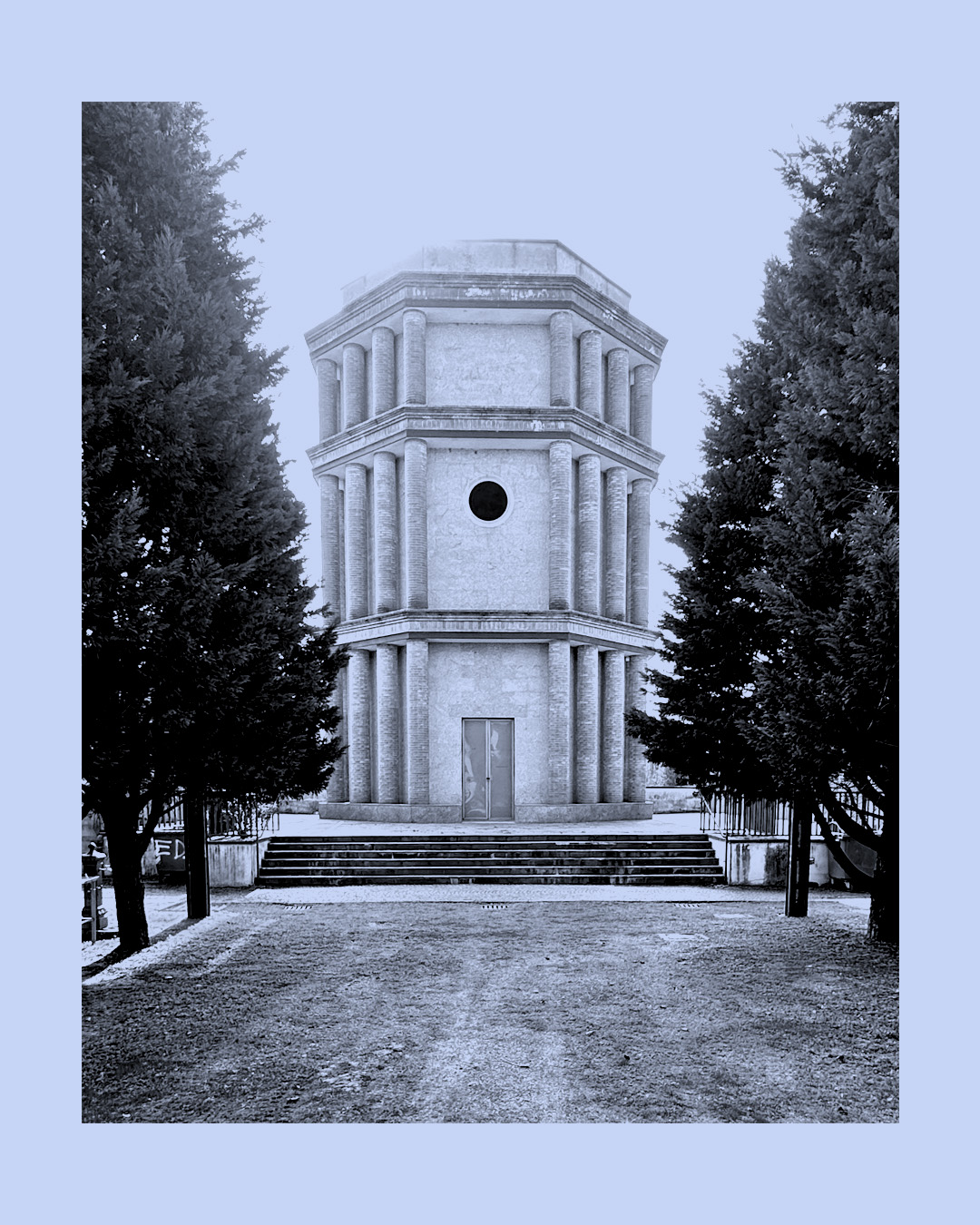
Fig. Aldo Rossi’s extension of the Cimiterio di Ponte Sesto in Rozzano with G. Da Pozzo and F.S. Fera (1989–1995), Viale alberato with chapel, Southern Periphery of Milan, March 2023, Photo: © Andreas Lechner
Core Group 2023
Cameron McEwan (Northumbria University + AE Foundation)
Andreas Lechner (TU Graz + Studio Andreas Lechner)
Elisa Iturbe (Harvard GSD + Outside Development)
Joe Wojewoda (Northumbria University)
Lee Ann McIlroy (Northumbria University + University of Dundee)
Lorens Holm (University of Dundee)
Neil Gillespie (Reiach & Hall + Scott Sutherland School of Architecture)
Sandra Bartoli (Büros für Konstruktivismus + Munich University of
Applied Sciences)
Silvan Linden (Büros für Konstruktivismus)
Yamina Saheb (OpenExp)
ARCHITEKT ANDREAS LECHNER
Attemsgasse 11
8010 Graz
Austria
![]()
Attemsgasse 11
8010 Graz
Austria

© Andreas Lechner. All rights reserved. Unless otherwise stated, all materials on this website and the ideas incorporated herein, as an instrument of professional service, are protected by copyright and other intellectual property rights belonging to Andreas Lechner, its affiliates or its licensors and all such rights are hereby asserted and reserved. No part of this website may be copied, reproduced, republished, posted, transmitted or distributed in any way for commercial purposes. Any modification or use of the information contained on this website for any purpose not explicitly permitted without prior written consent is a violation of the author’s intellectual property rights and is strictly prohibited.
Imprint
Imprint